Sunday, August 3, 2014

August Woodsmoke Class

The folks that predict the weather said we were likely to get some showers overnight. That would really dampen things for our class Saturday morning. I thought about throwing a tarp over the woodpile but decided against it.

My reasoning? Simple.


I may indeed be able to manipulate some things in a relatively controlled environment to make things easier for the class. But that would be cheating them. We do, after all, in real “out there” conditions have to work with Ma Nature on her terms. Sometimes she rains on us. And when she does we have to know how to deal with the dampening that wet conditions factor into the equation. If we do not know how to work with what she gives us … she will flat out beat us.

No overnight rain. The worst we had to deal with was a little dew and that large thriving flock of mosquitoes. Most of the dew had fairly well dried off before class and the smoke from the fire that I started a little early kept most of the mosquitoes hiding in the woods. The fire that I built? One good spark from a SPARKFORCE Mini ferro rod touched off the well prepared tinder nestled beneath the lay.

Proficiency, at anything, takes practice. None of us can become proficient at any skill without personally investing time and energy.

Identifying the basic life-essentials is simple … fire, water, shelter, food … and we have outlined what we need to sustain life. Becoming proficient in effecting and procuring the four essentials takes more involvement than being able to outline them on paper and parrot them back to an instructor.

 A one-spark fire does not just happen. A one-spark fire does not always happen.

Skills demonstration was the focus of our class time. Each student took their turn constructing a rain resistant shelter and a self-sustaining fire using items from their kits. One at a time affords me the opportunity to casually observe, assist, and advise one-on-one at point of individual need. The single largest thing that I needed to work with them on was getting their fire lay in order to achieve a self-sustaining fire … finely processed tinder, small kindling, larger kindling, small fuel, larger fuel.

We went about all of this in a relaxed fashion but I explained afterward that the whole process of constructing a shelter and having a fire going ought to be accomplished in twenty minutes or less. We are not timing things at this point. Another practice or two and we will start keeping a record of their time. Not that we are trying to establish any kind of pecking order or set any speed records. The reason is that real conditions in the wild may indeed insist upon skills proficiency.

I spent a few minutes talking with the guys about what we will be doing over the course of the fall and winter months … that the repetition is designed to make the skills they are learning more of a “first nature” than something they simply know a little something about … that these are all small steps equipping and preparing them for the early winter and late winter three-night trips we have planned this winter.

The three-nighters.

That is where the rubber will really meet the road. Out there … real wilderness … no water faucets … no light switches … no central heat and air … no indoor toilets … no radios, televisions, or computers … no cell service … . It involves a psychological adjustment for folks to make the jump from living civilized to living woodsy.

It was an interesting culinary change.

I have introduced the guys to some new foods cooked over the fire. Caleb pulled some peaches off the tree and made peach-kabobs. Yep. That was interesting.

Sunday, July 13, 2014

Woodsmoke Itinerary August Through February

So here is what we have going on through February.

August 2 – Student Proficiency Demonstration.

Students will demonstrate (1) Setting up a weather resistant shelter, (2) Building a self-sustaining fire using the methods they have been taught, (3) Processing charred material for fire making.

There will also be a block of instruction on cutting tool maintenance, water procurement, and water sanitization.

September 6 Camp Fire Cooking

We will not be breaking out the fire irons and cast iron.

Students will set up their shelters, build their fires, and use their kit items to prepare a meal.

Kits will be laid out for careful inspection and suggestions will be made for kit improvements.

October 18-19 WOODSMOKE BASIC ORIENTATION, Little River State Forest, Monroe County, Noon Saturday until Noon Sunday.

This orientation course covers the 4 major woodcraft-bushcraft-survival basics of shelter, fire, water, and food and requires an overnight. As an orientation the course content is designed primarily for newcomers that want to jump in.

This is also an opportunity for our already enrolled students to experience an overnight “on the ground”, practice the skills they have been learning, hike a trail, and fish the edge of the lake.

Instructional Fee for new registrants - $65.00 for adults. No fee for children accompanying their parents. Those taking the Basic Course will need to have a kit assembled in advance. Contact me for a list of what you need to have.

All visitors to Little River State Forest are responsible for their own camping fees and food items.

November 1 – Introduction to Subsistence/Survival Trapping

Students will be introduced to conibears, coils, and snares as a means to procure food.

NOTE: Land set snares (with the exception of powered foot snares) are not a legal means of trapping in this state. However, snaring is an effective means to provide food in a survival situation.

Students will learn to use items in their kits to manufacture snares, toggles, and triggers for spring powered snares.

December 5-8 Woodsmoke Early Winter Trek, On the Conecuh Trail in the Conecuh National Forest, Covington County. Noon Friday until Noon Monday.

This is an opportunity to deepen your experience, get away from the amenities of established campgrounds, and take advantage of one of the best natural resources we have close around our area. Winter, though it is coming on but doesn’t have us quite in its grips yet, will present its own sets of challenges and opportunities to put our skills into practice.

Although firearms deer season is closed the first 10 days of December, archery season is open. The wildlife biologist in charge of the area suggests that wearing some blaze orange is a good idea. I agree.

We’ll set our camp near a spring and ½ mile from a stocked pond. Might be we'll skin and cook some catfish.

Sorry folks. No newbie’s allowed. This is open to only those prepared here in our classes or in the October Orientation.

All trekkers are responsible for their own parking fees and food items.

January 3-4 – Trapping Camp. Noon Saturday until Noon Sunday in our outdoor classroom at the farm.

We will hike in, set up camp, set a few traps, and check them come the light of morning.

Ideally, this will provide an opportunity for the students to experience the process that involves trapping, dispatching, skinning, and processing the meat of an animal.

February 13-16 Woodsmoke Late Winter Trek, On the Conecuh Trail in the Conecuh National Forest, Covington County. Noon Friday until Noon Monday.

The woods change a lot over the course of the winter. Late winter can bring some cold temperatures to this part of the country. This trek builds upon the experience of the early winter one. By this point, students should feel quite at home in the woods and have honed their basic skills until they comfortably own them.

Sorry again folks.

No newbie’s allowed on this one either. This is open to only those prepared here in our classes or in the October Orientation. Those that have been through orientation and missed the early winter trek are welcome to take part in the late winter one.

All trekkers are responsible for their own parking fees and food items.


I am really looking forward to what we have planned over the coming months.

[PHOTO] 8 miles from the truck on the Conecuh Trail. No cell service. No worries. No hurries.

Tuesday, June 24, 2014

Somewhere ... Sometime ... Somebody

I can make no apology when I say that folks ought to develop and hone a kit mentality.

I have my assorted reasons.

On one end of the reason-scale are the unplanned situations and circumstances that can and do arise along the course of life. Somewhere … sometime … somebody … is going to encounter life/health threatening circumstances. It might be any one of us that the search and rescue team is trying to find and get to. Thinking through the long list of possible scenarios and doing some planning and preparation ahead of time can and does save lives. It might be our own or those of our loved ones we are saving.

On the other side of the scale are the many back-to-basics possibilities to get out and enjoy being surrounded by nature where we are groomed and caressed by its terms of engagement … away from the deafening din and growing piles of debris created by society and its myriad social aspects. We learn to understand and partner with nature. We begin to view, respect, and appreciate nature as an ally.

It is this side of the scale that I consider most important. The more groomed we are on this side of the scale the better prepared we are for the possibilities that may arise on the other side of the scale.

It is not difficult to put together a good usable kit to get started. Putting one together from scratch will involve some expense but putting one together does not have to break the bank. I do not recommend scrimping too tightly though. Cheap is not always a bargain. Cheap is all too often just that … cheap. Cheap will let you down a lot sooner than something with some quality to it and it often does just that when you least need it to. Cheap can also make you work harder at simple woodcraft tasks. Expensive, on the other hand, can be merely just another bag of status wielding conversation pieces. I think it is important for people to discover their balance between these two extreme ends.

I have already talked about The Basic Kit and its contents back in April so there is no good reason for being redundant here where kit contents are concerned. I do think it is important to continue to emphasize the necessity of developing and honing a kit mentality. A kit mentality needs to be an everyday affair that we are engaged in. It is simply that important. Think about it. All of life’s necessities … shelter, fire, water, and food … revolve around the basic kit and the personal capability to utilize its contents on any given day in any given set of circumstances.

It is important to know how to effectively use the items in the kit. It is more important … perhaps even paramount … to have a good working knowledge of the environment that surrounds us.

I consider myself fortunate to have lived in three countries on two continents and in several climatological regions of this country. Each climatological environment has its own particular demands and hardships. Each climatological environment also has its natural offerings and rewards for those that know how to identify and utilize the available resources.

Here is where the real schooling begins to take place and I readily admit, for all I know, I have about a bucket of knowledge in comparison to the amount that is in the well waiting for me to haul it out. What Horace Kephart said is true. “In the school of the woods there is no graduation day.”

Woodcraft or bushcraft or whatever you choose to call it is a lifelong school. There is something new, several something’s in fact, that can be learned every day if we are curious and attentive … if we are willing to take the time and invest the effort to dip our bucket into the well.

Acquiring knowledge in the real school is a long course aggravated by the fact that the more advanced and technological housed societies become, the more domesticated and urbanized societies become, the less these societies honestly know about how to live on their own and how to identify and utilize the life sustaining resources provided by nature. For most modernites, if it does not come from the store or the restaurant … it does not come. I know this first hand. I too lived a big part of my life as a supply chain dependent and still do the convenient easy thing where the supply chain is concerned for convenience sake. We all do and we all will as long as we live in or near the settlements.

Given the necessity to forage wild edibles and to hunt or catch, kill, and process wild animals, fish, and birds for food, most modern Western Civilization residents would go hungry in the short term and starve to death in the long term. A hard course in deprivation and starvation is honestly avoidable. Nature abounds with what we need and can have if we take the time to accumulate the knowledge, experimentally familiarize ourselves with her bounty, and develop the skills necessary to utilize the bounty nature has to offer. Will we give up the grocery store as long as its shelves are stocked? Probably not. I have not anyway.

What if things take a really bad turn? What if we discover ourselves in a dire long term situation that cancels out the likelihood of rescue or being provisioned? It is just me, or just you, or just us along with our kits and the knowledge we have taken the time to accumulate?

I do not have a personal frame of reference for this scenario. I have never crashed in a plane on the side of a snow covered mountain. I have never been shipwrecked and marooned on a deserted island. I have never broken down off road in the desert. At least not yet. If I venture there is the possibility.

I have been through a good many hurricanes and had a couple close calls with tornadoes. I have bivouacked in the Army and camped as a civilian in some miserable conditions. I have a lot of personal reference points but I have never been in this sort of dire long term situation and hope that I never personally add them to my frame of reference.

Hopefully … none of us will. 

Sadly … somewhere, sometime, somebody will.

Borrowing the words of John “Lofty” Wiseman …

“You can have all the knowledge and kit in the world but without the will to live you can still perish.”

Wiseman is one of the respected “experts” on the subject of survival. He spent 26 years of his life as a professional soldier and served with the British Army Special Air Service before becoming the survival instructor to the Special Air Service. I have a lot of respect for someone with those credentials.

He makes this statement in his introduction …

“Survival is a mental exercise.

After the excitement of the incident and the rush of adrenalin has settled it takes great mental resolve to carry on. What keeps us going is the basic instinct, which is best referred to as the will to live.

This is the firm foundation that we build all of our training on and try to nourish and increase.

It is easy to see how physically fit we are but very difficult to know how mentally fit we are.

This basic instinct is getting weaker as we get more civilized so it is important to practice our skills, and be prepared for any eventuality.”[1]

Practice all you can.

Learn all you can.

Experience all you can.


[PHOTO] Wiseman’s Pyramid of Learning


[1] John “Lofty” Wiseman, SAS Survival Handbook, How to Survive in the Wild, in Any Climate, on Land or at Sea © 2004 by HarperCollinsPublishers. Copyright terms respected.

Wednesday, June 11, 2014

Constructing A Fishing Pipe

I finally got around to doing it.

I have wanted to do it for quite a long time, ever since I watched a Dave Canterbury video about it on YouTube some years ago. I just never set myself to the simple task. Watching the videos that Nate Hains posted kindled a fire under my fanny. Yep it was time to get busy.

The rig is really a smart idea.

If there is water around there are fish. Whether for the simple pleasure of catching and enjoying a meal of them or desperately needing them for food in a survival situation, there are fish to be had if you have a means to catch them.


Shirli and I both carry fishing gear in our kits … line, a couple sizes of hooks, split shot, floats that we call bobbers around these parts, a few pan fish (we call them brim) jigs, and small artificial baits that look like earth worms. Who knows? Live natural bait might be elusive and hard to find so carry something artificial just in case. Always be prepared.

The thing that really sold me on the idea and prompted me to put these together is the fact that you can cast them and get your baited hook out farther than you can when using a short sapling as a pole. A pole that is long enough to do some good is also hard to manipulate in dense cover. Especially overhead cover.

Of course I had to add a little personal touch to these fishing pipes.

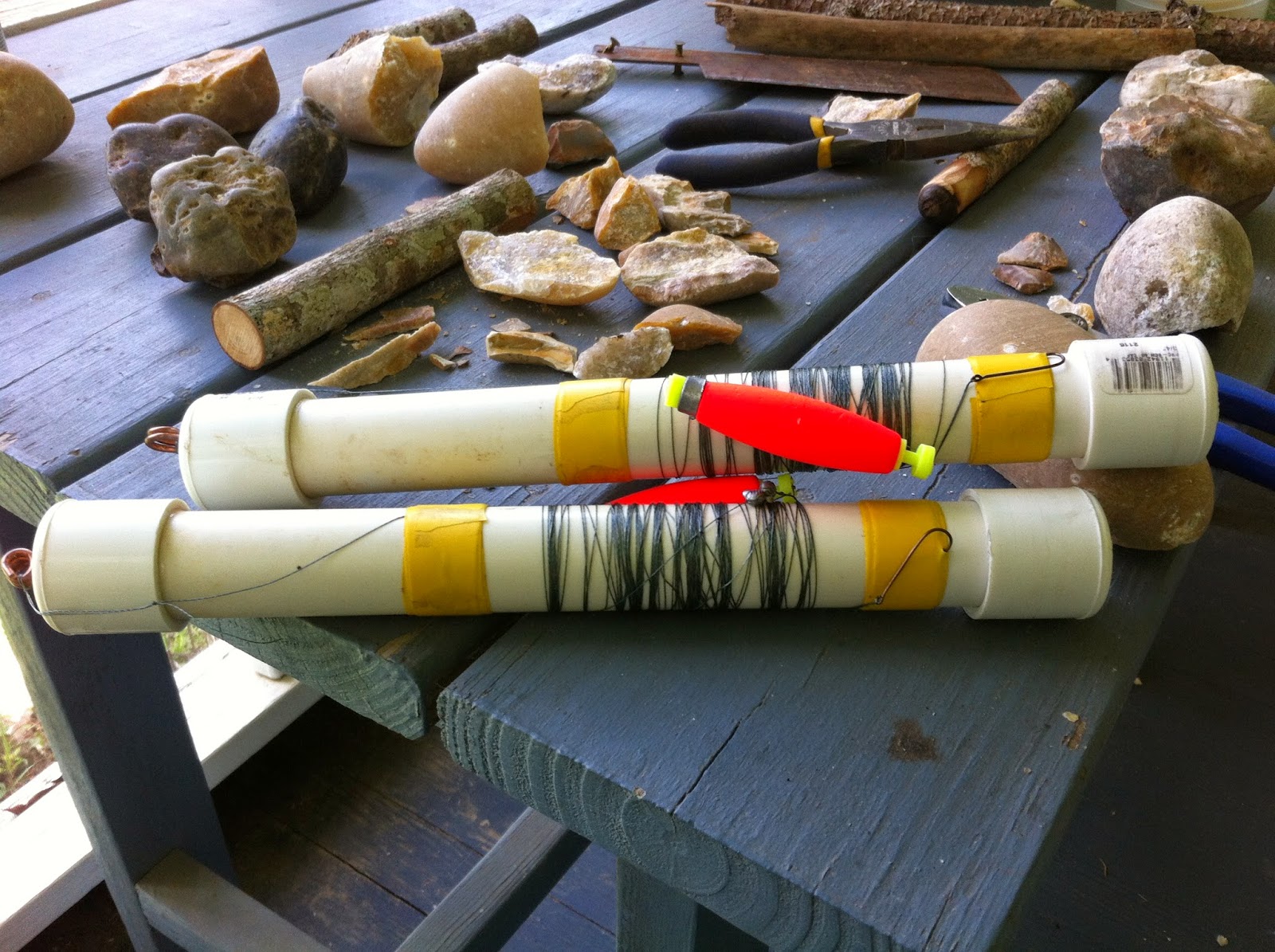
One was to affix a little contraption to the butt end cap to attach the line to rather than tying it around the pipe.

I drilled a small hole, put several circular bends in a short piece of solid copper wire, inserted that into the cap, and then did the same circular bending outside. It is secure inside and out. On went the cap with some cement and it is a permanent fixture on the fish catching device.

The other end is not glued on. The pipe becomes its own small tackle box. I did do a little light sanding on the pipe so the front cap is not as likely to get stuck on so tight that it is difficult to get off. I also sanded the burrs and sharp edges on the cap that might interfere with casting and retrieving the line. On went the cap.

Next was to measure off the line, attach it to the copper wire, and wrap it onto the pipe. I used 30 feet of 20 pound test braided line. I figure that is plenty long enough for these waters. Once the line was on I applied several wraps of electrical tape. One holds the tail end of the line in place on the pipe so it cannot wander around and get loose. The other makes an ideal place to hang your hook between episodes of fishing or when the fishing rig is riding on the truck seat. You know … for those times when you might be driving by a spot and can wet a line for the heck of it.

During transport in a pack the attached bobber can be slid down close to the split shot and the whole catching end stored securely inside the pipe.

I got to thinking about something else this rig can be used for that increases the possibility of catching fish … catfish in particular.

Measure off as many 30 foot sections of #36 bank line as you care to fool with or figure you might need in your given situation. Roll them securely and have them handy in your kit. They can be attached one at a time to the fishing pipe, rigged with a good catfish hook and baited, cast out, detached from the pipe and secured to a root or tree, and left overnight to do their catching thing while you are tending to other important stuff around camp. The bank line is out deep enough to do more good than if the bait was laying in shallower water.

With a little overnight luck you might be cleaning catfish for breakfast and have enough for leftovers at noon.

Saturday, June 7, 2014

Woodsmoke Woodcraft School June Training Class

The app on my phone said it was 86 degrees. 

Hot enough. With the humidity factored in the felt temperature was 97 degrees as I packed my kit and made for some respite in the air conditioning.

No regrets. This is more than well worth the sweat in lower Alabama summer conditions.

It was a good training session with the guys.

I went down to our outdoor classroom in the bottom early enough to set up my shelter and get a fire going. The fire was needed, not for warding off any cold, but to smoke the mosquitoes out of the bottom, process some fire making material, and cook up a little survival culinary surprise for the group.


Mosquitoes? More than plenty of them until the smoke got going.

Get away from developed sites and level is not always easy to find. 

Somewhat level is. 

In fair weather somewhat level is fine. When a sure enough rain comes along to add some challenge to an adventure, somewhat level can put a river running through your shelter.

I showed the guys how to improve their shelter for wet weather circumstances with items in their kit.

The first thing was to tie a short string to the line attaching their shelter to a tree to work as a redirecting water stop for water running down the tree trunk, following the attaching line, and dripping into the shelter. The string needs to be a couple inches from the tarp.

Some water may make it in but with the shelter pitched to protect against the wind, most of the dripping water will be blown away from the shelter opening.

The next was to lay out their ground covering in a way that 3” diameter logs (cut with their folding saw) can be laid inside the shelter on top of the cover. The loose ends of the cover are then wrapped over the small logs. With the wrapped logs 6 inches back from the sides and front, water running off the sides of the tarp or coming down a grade will not end up running beneath the shelter soaking everything.

The guys have watched me on several occasions using primitive flint and steel to get a fire going. They have used modern flint and steel … ferro rod and magnesium bar … to effect fire.

Today was their turn to utilize a rock and fire steel. There is a certain finesse to primitive flint and steel. It is something that you develop a feel for. The right angle. The right speed. The right amount of force of the steel against the rock. There is something about primitive flint and steel. Once you find that certain finesse … once you get onto it … it has a way of becoming your fire making go to.

I am a huge fan of charred cloth. The stuff works great. Cloth is not necessary though. Not as long as the woods produces an abundance of punk.

I showed the guys my container of charred punk, used my rock and steel to throw a shower of sparks into it, and we watched as some white spots began to grow on the char. I told them that the only way I know of to put it out is to drown it with water or deprive it of air as I put the lid back on the tin to snuff it out. I then took out a piece and showed them how easily it catches with a magnifying lense. That char went back into the tin and was snuffed.

Once it was out, I dumped the contents on a piece of bark from a River Birch, set the char where it would be safe, filled the tin with fresh punk, and placed the tin on the coals to cook. A container is not absolutely necessary for the process. It is a convenience though and a good place to keep the char once it is cooked. Punk can be effectively charred by digging a hole beneath where your fire will be built, putting the punk into it, covering it with dirt, and building your fire on top of it.

I would not tell them what it was and there was a good bit of curiosity. They did some guessing but none were close. I whittled a nice skewer from a small oak branch, speared the breasts, and propped the skewer on a forked stick that I pushed into the ground close to the coals.

Our blueberries are almost ripe. We are not the only ones that have noticed and there is an army that visits our bushes every year about this time. I have tried everything I know to keep them at bay. Nothing, so far, has worked. So I popped three of them with the fancy .22 Benjamin air rifle that I got myself as an early birthday present, pulled their breasts, and stuck them in the freezer for such an occasion as this. You know, after all, in a real survival situation you eat what you can get.

I had never eaten it before but I have got to tell you. Blackbird ain’t half bad. In fact, blackbird roasted on a green stick over an open fire is pretty dang tasty! I’ll bet if they were wrapped with bacon and seasoned a little they would be as good as any game bird I have ever eaten.

Oh. How did the charred punk turn out? It cooked up just fine. We gave it a test with a rock and steel. A good shower of sparks and there were several white spots beginning to grow and glow.

Sure.

I will admit it.

I think all young people ought to be taught to use cutting tools and build fires. 

It’s awful hard to skin a squirrel or get a campfire going with a computer keyboard or the controls to a video game.

Sunday, May 18, 2014

Toasting Punk

I had a hot bed of pecan wood coals in the pit after working up something tasty for the supper table. Supper was done. The coals were waiting. 

It was time to toast some fire making materials.

My fire starting go-to is a fire steel and charred cloth. Flannel, out of all the 100% cotton offerings, is my favorite cloth for charring. It is soft and fluffy and seems to take a spark a lot easier than tighter woven materials.


This is not the only fire starting means that I carry in my kit. There is a bic lighter in there. There is a magnesium bar and ferro rod in there. I just happen to like old school

I am, where old school is concerned, still working on the bow drill method. I do not imagine the bow drill ever becoming my go-to fire starting means. Not as long as I have some hard steel and a sharp rock to cut red hot sparks. Friction fire just happens to be one of those good to know things.

Friction fire predates everything but lightening for getting a fire going. It has a certain mystique about it that makes it attractive. I do question its reliability here where the humidity is always high, rains are more often hard and heavy, and things tend to remain at or beyond the damp side of the scale. 

I would not want to have to depend on it. Maybe in a dryer climate. But not here.

Charred cloth. It dawned on me at our last class that I have gone through my little stash of the valuable resource. Time to replenish the container that I carry in my kit.

We do not have to rely on the textile mills to provide us with material to char. Charred cloth is convenient, handy, and readily available close to the settlements. However, in a long term situation where replenishing resources is a serious matter, we do not want to waste a good bandana or toast our cotton underwear to have material to get a fire going. Not when Ma Nature provides us with all the natural materials we need for the fire making purpose.

I am always picking things up when I see them.

Especially good fire making resources. 

It is like they are waiting for me to happen along, find them, and add them to my stash. 

I think this collecting business happens to folks when they begin making a priority of identifying and utilizing natural resources. It is amazing how much there is laying around waiting for us to recognize its usefulness.

The punk wood had fallen out of a live oak in town. A piece from a small limb. It had been run over a few times but there was still a nice bit of it that was usable. 

I stuffed it in a small bag and put it in the truck.

Throw some sparks in the tin of char, hold your tinder bundle on top, blow on it until the bundle ignites, then put the lid on the tin. Charred punk is great stuff. It takes a spark nicely and gives off a lot of heat. Once it is going you have to either drown it, suffocate it, or let it burn out on its own to put it out.

Hence the need for a tin with a tight fitting lid to choke off the supply of oxygen to put out the burning charred punk.

The tin will get quite hot. Give it time to extinguish and cool down before packing it away in your fire bag.


Sunday, May 11, 2014

Hydration And A New Pot

Hydration is an important health issue.

We do not give it a lot of thought as long as we are close to a faucet or can grab a bottle out of the cooler at the grab it and go store. Get away from the settlements and established parks and drinking water has to be either hauled on your back or processed from whatever sources you happen upon.

We need water to stay hydrated. We need water to flush toxins and other junk out of our systems. Without water we can be dried-out dead in 72 hours. We become debilitated before we become dead.

My canteen holds a quart of water.

On a normal day I need to drink at least three canteens to keep hydrated. Let the summer heat come on like it does, along with sweat running out my pores like water through a sieve, and I need to increase that amount. Easy to do when I can turn on a faucet. Not so easy to do when there are no faucets and every source of water needs to be considered with suspicion as potentially dangerous.

I really like the Stanley cook pots we carry. They are great for stewing up a small meal or boiling some water for tea or coffee. 20 ounces though is way short of the quart that it takes to fill my canteen. It is also a bit small for boiling a grown squirrel that would be too tough to chew if cooked on a stick over an open fire.

So I have been pondering the cook-pot dilemma for some time now and have looked at some of the bush pot offerings that can be had. Nice pots but that thrifty side of me balked like a mule at the price they go for.

I was in Walmart a few days ago picking up some things and found what I considered to be the perfect pot for my purpose. Stainless steel with a lid. Holds a little shy of half a gallon. It was not in the pots and pans section. It was, of all places, in the pet section and made to hold dog treats.

$6.00.

My thrifty side latched onto it and brought it home.

The lid had a rubber gasket on it that I pulled off and threw away as soon as the pot entered the house. Two little holes drilled, a piece of metal coat hanger bent to fit, and the bail was attached. Ready to go to the woods and get blackened over a fire.

A stainless cup with folding handles sits in the bottom of the dog biscuit pot. The Stanley pot sits inside the cup leaving room for stuff like a dish rag or pot holder. The downside is that the lid will not fit on the pot when the other items are in it. Not a problem. The lid does not occupy much space. There is room in my kit for it tag along.

The pot comes with some stamped embossing around it. Dog tracks.

I told Shirli that I thought about hammering out the embossing. She told me those were bear tracks and to leave them alone.

Yep.

Bear tracks. That's what they are.