Sunday, April 5, 2015

April Class Recap

It is a different world out there.

In the woods.

Under the trees.

Any woods, any trees, any time of the year.

We have gone through a transition here in this part of the world. Winter is gone. Spring is full-blown.

The creatures that slither on their bellies are now out. So are the mosquitoes … not nearly as bad as they will be in another month … but down in the bottoms and around the swamps the mosquitoes are already pretty aggravating. It is easy enough to avoid the fangs of these slithering vipers that the south is famous for. Mostly moccasins here where we are. And a few copperheads. You don’t have to go far though to begin encountering Eastern Diamondbacks.

Situational awareness is the key to avoiding their venom. Always know what is overhead, around, under your feet and where you are reaching. Snake boots, for any warm weather woods goer, are a smart investment. Their cost greatly outweighs the health consequences and expenses associated with anti-venom treatments.

The mosquitoes are another story. You either wear something to repel them or keep a smoky fire going to keep them driven away. I am not a fan of DEET. I would rather use something natural to avoid the strong chemicals. REPEL has a DEET-free product on the market that is supposed to be all-natural. It does repel mosquitoes but I think it stinks to high heaven. Get it on your lips and you’ll taste it for a couple of days.

Crushed Wax Myrtle leaves rubbed on exposed skin repels mosquitoes. So do the crushed leaves of American Beauty Berry. The Wax Myrtle is an evergreen shrub that grows into small trees. Beauty Berry is a bush that is just now beginning to put on their annual leaves.

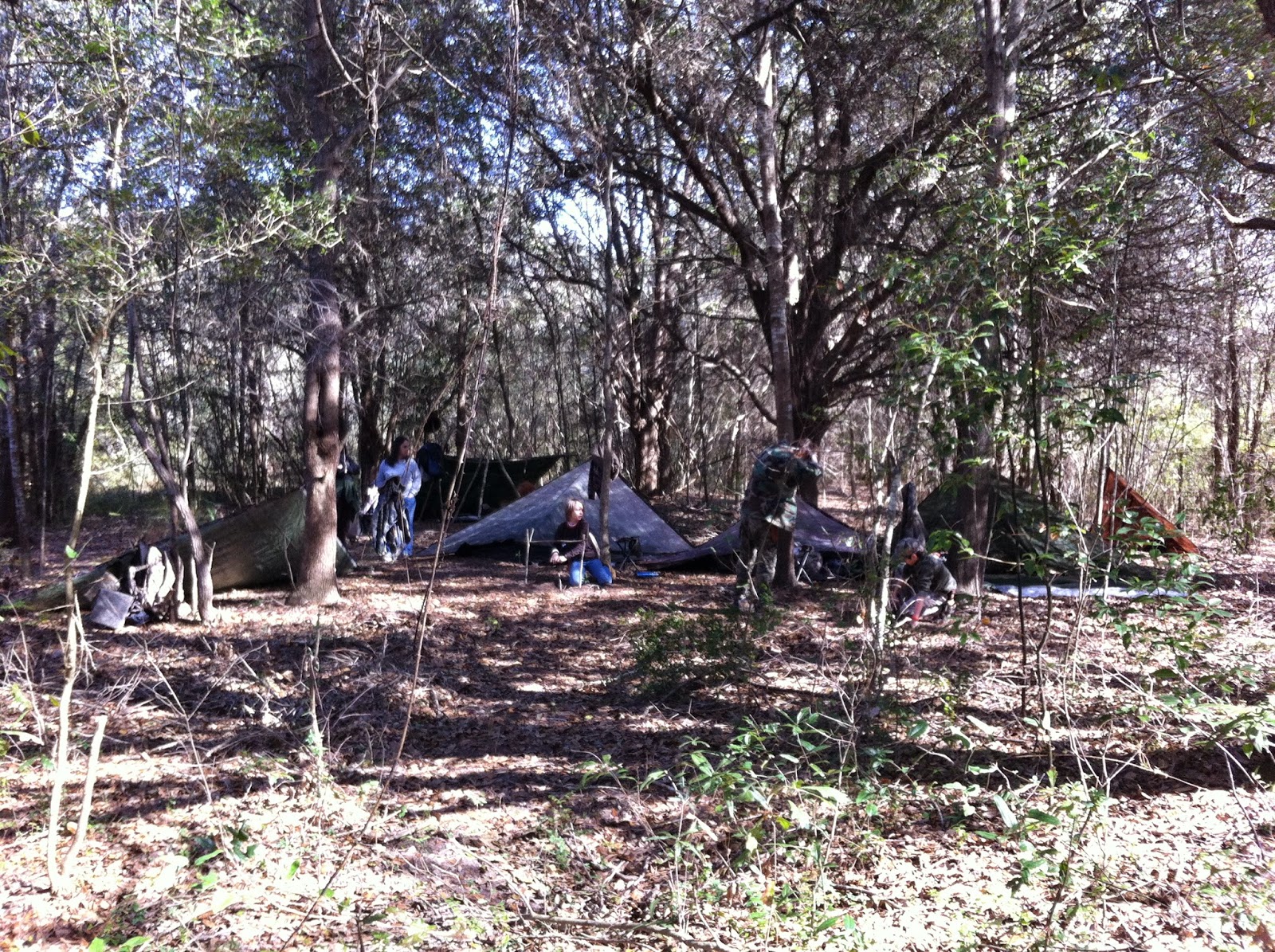
Shirli and I made our way back to the classroom an hour early. We got a smoky fire going to chase the mosquitoes off the knoll and down into the bottoms that surround it. The live oaks have shed their leaves since we were back there a month ago for the compass reading and land navigation class. All the other oaks shed their leaves in the fall and early winter. These Southern live oaks wait until spring to do their shedding. That dense layer of dry brown leaves made for a nice floor in the woods classroom. Nature’s short-shag carpet.

I walked out to meet the group and escort them on their hike in to the class. On our way in a mature green garter snake was making its way across our path. It’s always pleasant to see a “friendly” under your feet. That is the first green garter that I have seen on the property and I consider it one of the indications of how nature rebounds when areas of land are left to follow their natural design.

The primary focus of our class was using common items normally in our kits to construct a simple unbaited trail snare for small game.

I always preface any discussion of snares by reiterating that the devices are not a legal means to harvest fur bearing animals in Alabama. There are other legal ways to trap during trapping season and those, during prescribed seasons, are the way to go about the task of trapping. A lot of folks get real squirrelly when you talk about trapping animals. I personally have no problem with it. Especially no problem with it when it is done as a means of subsistence. People need food to live. Animals are, among other things, food.

Trapping is a skill that is fast going by the wayside. It is also a skill that will feed you. In certain types of situations possessing this skill and the tools to utilize it can mean food on your table or in your camp. Snaring, in a genuine survival situation, can mean the difference between starving and staying alive.

Accomplishing the primary focus … constructing a snare and triggering mechanism … involves working with tools. Cutting tools. It can be accomplished solely with a knife but a folding saw makes some of the cutting tasks simpler. So there’s two tools that serve useful purposes in the process.

I collected a length from a small sapling and sat down to saw and whittle the finished product. It started to rain. Nothing like a deluge but it was one of those steady lingering things that gets you soaked anyway. We were there. We were committed. Sometimes you get rained on in the woods. It’s just one of those matter of fact things that you can’t get around.

I explained that the trigger mechanism was going to have some exaggerated dimensions so it would be easier to see exactly what I was doing and how I was doing it.

The sawing and whittling opened up the opportunity to talk about safety as I worked with an extremely sharp knife and a folding saw that will take chunks of meat from a finger. One of the things that I emphasized was the necessity to wear a leather glove on the hand that is apt to get cut if you slip. That’s bad enough of a thing to happen at home when you are close to a medicine cabinet or a doctor handy with a stitching needle. Deep in the woods is the wrong place to get a cut of any kind. Another door of teaching opportunity gets opened ...  about the natural antiseptic known as pine sap.

There is honestly no end to the woodcraft and woodlore topics that naturally begin to flow when demonstrating skills. The natural flow is one of the things that I enjoy about the relaxed style of teaching that we are doing with this group that we are mentoring. It’s hard to put together an exact outline of instruction. Quite often I just get into the primary focus and let the rest naturally unfold.

I finished my trigger mechanism and snare, found a suitable small sapling for the spring, marked out an imaginary rabbit run, made the set, and set it off with the rabbit at the end of my arm.

Something of a side note. It is not necessary to peel the bark from the component parts. I think it makes for less friction at the contact points. The peeled sticks are easier to see when checking a line that has been set. Set aside and given a day to dry and those bark peelings will be great kindling to assist in getting your fire going. Peeling sticks is also good basic training in knife handling.

Now their turn to collect their materials and whittle.

I left my finished product where they could look at it as an example but, for the most part, I wanted the class to reproduce the product on their own then demonstrate the workable function of their finished product.

There’s a lot of learning in that process. Listen to instructions and observe what’s being done … closely duplicate what you have observed … test what you have attempted to duplicate. If it works the first time … you’ve done a good job. If it doesn’t work … you haven’t necessarily done a bad job. You just need to focus and keep working at it until you do get it. It’s all about developing skills and practicing skills.

And all the while a steady gentle rain was falling to add a nice sense of wilderness survival ambiance to a class that was focusing on a wilderness survival skill. I thought it was a really nice added touch to the class.

Today marks a year and a month from the Saturday morning when this group met for their orientation class. They have come quite a long way in these 13 months of mentoring. The group has garnered a good bit of experience through these classes and camps.

They are not the only ones benefitting from the experience. They inspire me to keep digging deeper, learning new things, dusting off and rehearsing old skills. Kephart nailed it when he said, “In the school of the woods there is no graduation day.” We are all, in the school of the woods, perpetual students. There is always something new to learn. Older familiar things will always catch light to reveal another facet that we’ve not seen before.


So, as a little closing ceremony to our rain soaked class, we presented Basic Woodcraft Skills Certificates of Achievement to Jude, Gage, and Caleb to recognize, acknowledge and affirm their personal growth and achievements in their woodcraft adventures. 

Thursday, March 26, 2015

2015 Calendar of Outdoor Workshops And Woodcraft Camps


WOODSMOKE WOODCRAFT SCHOOL

Building Confidence through Knowledge, Skills, and Resources

A School of the Woods Focusing on Woodlore, Woodcraft Skills, Wilderness Survival, and Self-Reliant Living


2015 Outdoor Basic Skills Workshop Series


Orientation Workshop – Phase I
May 9, 2015
10940 Danne Lane, Fairhope

     Minding the Rules of Three
      Building a functional kit and developing a kit mentality
      Every Day Carry (How far have I got to go?)
      Vehicle Kit
      Gear that you need
      First-Aid
      Hygiene and Sanitation
      Dealing with ticks, chiggers, and mosquitoes


Fire Making Workshop – Phase II
June 13, 2015
10940 Danne Lane, Fairhope

      Primitive flint and steel
      Modern ferro rod
      Magnifying Lens
      Friction
      Tinder, kindling and fuel
      Fire Lay
      Dakota Fire Hole
      Making char cloth and charred punk


Shelter Workshop – Phase III
July 11, 2016
10940 Danne Lane, Fairhope

      Tarp Set-Ups
      Winter Conditions
      Summer Conditions
      Dealing with Foul Weather Conditions
      Constructing Semi-Permanent Shelters


Hydration Workshop – Phase IV
August 8, 2016
10940 Danne Lane, Fairhope

      Natural vs. Chemical Contaminants
Water Sources
      Digging for ground water
      Making it safe to consume
      Evaporation and Distillation from the ground
      Collecting water from green growing shrubbery
      Tapping (Birch in the spring)


Staying Fed Workshop – Phase V
September 12, 2016
10940 Danne Lane, Fairhope

      Open fire cooking
      Packables for the short term
      Procuring for the long term
      4-F’s of Survival … Fish, Feathers, Fur, and Foraging

Primitive Archery
Sling shot
Snares
Fishing/Frogging Spear
Throwing Stick
The versatile .22
Wild edible plants
Insects
Steel traps (Conibear 110)
Rat trap

      Animal Diseases (Rabies and rabbit fever)


Staying Found Workshop – Phase VI
October 10, 2015
Location to Be Announced

      Compass reading and land navigation


Fall Woodsmoke Overnight Gathering
November 14-15, 2015

      Overnight at Little River State Park – Atmore, AL
      Opportunity to utilize gear and skills in an overnight setting
      Recap of course content
      Dress rehearsal for the upcoming Early Winter Wilderness Trek
      Opportunity to meet and get to know other woodcrafters

There is no charge for students that have completed Phases I through VI.
Individuals attending the gathering are responsible for their own park fees.


Early Winter Wilderness Trek
December 4-7, 2015

      Early Winter Wilderness Immersion Experience - Conecuh National Forest

There is no charge for students that have completed Phases I through VI.
Individuals participating are responsible for their own parking fees.


Pack-In Trapping Camp
January 16 -17, 2016
Cost: $125.00

      Introduction to traps and trapping
      Snares and primitive triggers for use in survival situations
      Conibear traps
      Foothold traps
      Dog-proof traps
      Making effective sets
      Dealing with trapped animals and processing the catch


Late Winter Wilderness Trek
February 19-22, 2016

      Late Winter Wilderness Immersion Experience – Conecuh National Forest

There is no charge for students that have completed Phases I through VI.
Individuals participating are responsible for their own parking fees.


WORKSHOP FEES

Individual workshops - $40.00 per student age 18 and over.

No charge for minors under age 18 accompanied by enrolled parent or responsible guardian.

Class size is limited to 7 adults.

Pre-registration and payment in advance is required.


INTENSIVE BASIC SKILLS WEEKEND COURSES

Intensive weekend courses that cover Phase I-VI can be scheduled.

Intensive courses run from 9:00 Friday morning through 12:00 Sunday.

Cost: $240.00


Waiver of Liability

While safety is our primary concern, individuals participating in these outdoor programs realize the possibility of accidents and injuries and assume all responsibility for their own personal health and welfare.

A Waiver of Liability that holds Woodsmoke Woodcraft School, its instructor(s), students, and program/event hosts harmless must be signed and on record before participating in any of these outdoor programs.


CONTACT ...

David Kralik

email ... matthewfivesix@hotmail.com 

Subject Line ... WOODSMOKE REQUEST

Inform me of your interest and I will return correspondence.


Monday, March 23, 2015

Treasured Gains and Ignored Losses

Spring, by the time the calendar says it is springtime in this part of the world, is wide open and has been for a while. Except for short bursts of winter-like temperatures, we really do not have much winter on the lower Alabama coast.

At least nothing winter-like that compares with northern winters or out west in the Rockies. What we have is essentially a good long spring that starts along about the time folks up north begin shoveling snow and dealing with freezing drizzle … a spring-like season that lasts until summer conditions arrive long before the calendar says it is summer.

It is not a bad climate zone to live in … other than what we have to deal with where summer heat and humidity is concerned. And the occasional tropical storms and hurricanes that blow in off the Gulf of Mexico. Those can be messy affairs. The bad ones, the ones that give The Weather Channel something dramatic to report on, have a way of seriously rearranging the landscape and creating some severe challenges for people.

Summer vegetation and deciduous trees go dormant in the late fall of the year. Some of that has to do with a little frost that nips them. Most of it though has to do with the change in the amount of available light. The slight tilting of the planet changes the length of the daytime and nighttime hours and things go into winter hibernation.  Perennial vegetation regenerates from its roots in the spring after resting through the winter. Annual vegetation that is temperature sensitive simply outlives its time, dies off, and waits for the soil to warm before regenerating from seed.

The cooler autumn temperatures signals something in the cool weather loving plants that brings them to life from seeds deposited before dying off when the longer days and warmer temperatures come around in the spring.

Then we have our assortment of evergreens.

There is … warm weather or cool weather … always something green coming and going in this part of the world. Our winter world is never totally grey.

Quite a lot of the wild vegetation is edible when you know what you are looking at and how to use it. Not only is a lot of it edible. It’s nutritious. Not only is it edible and nutritious. Some of it is downright tasty. A different sort of tasty than what we are used to but tasty nonetheless.

Edible, nutritious, and tasty?

That is knowledge worth knowing. 

During good times it adds some interesting variety and an added dimension to the world we live in. It adds generous measures to our seasonal situational awareness. Those generous measures build personal confidence. We are daily … summer and winter … surrounded by valuable life sustaining resources that could, in a really bad situation, add to the possibility of getting through it and coming out on the other side alive and well.

I am always amused me when I hear people make the statement that if things get really bad I’ll just head to the woods and live off the land. Living off the land … deriving everything we need from its abundant resources … is a full-time every day occupation that requires a lot of personal savvy and some human powered tools that most people do not have at their immediate disposal. The emotional and psychological adjustment would drive most people into a state of depression or outright madness in a hurry.  Even with a well-equipped kit. Most modernites are not mentally geared to live off the land in the woods. The psychological factor is just one of the simple realities in the mixed bag of reality matters.

It is interesting how the natural world works. More than interesting. It is fascinating when you take time to consider it and how integrally and intimately connected we are to its cycles of life. Our own health as a species sharing the natural world with other species depends upon the health of the natural world and the other species inhabiting it. The natural world, and the other species that inhabit it, would get along just fine without our species tromping, polluting, abusing, and depleting it.

I think the main reason for the lack of modern interest in the natural world and its cycles of life is simply because people today do not view the natural world as the source that sustains them. It is basically a sustenance issue. As long as the food train is running … as long as the stockers are working … as long as the shelves and coolers at the stores are full and the cashiers are scanning at the check-out stations … there will always be a disconnect where the source issue is concerned. 

Stores, folding money, and plastic cards will remain the source of sustenance for folks as long as these three remain viable. People will remain oblivious to the real source and their dependency upon it. And, in the process, people will continue to abuse and damage the real source.


It is a really sad modern tragedy in these times that are our times. In examining, admiring, and polishing our treasured gains it is terribly easy to overlook and ignore our losses … despite their immense value that goes unnoticed and unrecognized by the vast majority.

Wednesday, March 18, 2015

Woodcraft Priorities

Television has done a lot to promote what goes on in the world of woodcraft.

The promotion is a good thing.

It has raised a lot of interest in crafting ... whether you call it woodcrafting, bushcrafting, wildcrafting, survival-crafting, or whatever-crafting … this business of getting out beyond the security lights, showers, flush toilets, and other rental amenities where most people go to camp for a few days. My preference is to refer to the craft by its American title … woodcraft. 

If I were Canadian, European, or from the Land Down Under I would lean toward their bushcraft designation. But it really doesn’t matter what you call the craft. It is what it is and it defies all our attempts to name it. It overcomes the barriers imposed by nationalities, languages, and continents. It spans the ages ... from the Stone-Age to the Modern-Age.

Historically, here in this country, the craft was called woodcraft by those who practiced it.
The titles of two books come to mind.

Woodcraft and Camping by George W. Sears a.k.a. “Nessmuk,” a series of magazine articles first published as a book in 1920 … and The Book of Camping and Woodcraft by Horace Kephart with the first edition copyrighted in 1906. Two classics. Both of them written … lived before they were written … at a time when woodlore and woodcraft skills were a much more common commodity than they are today in our more sophisticated times. Both are really good reads and well worth adding to any woodcraft library.

My sticking to the American designation is likely partly a dose of American mule-headedness. A large part of it though is simply out of respect for the guys and gals that lived the life blazing and hewing out the woodcraft path here, leaving behind legacies of lives well lived.

The generated interest is a good thing. The revival of interest in woodlore and woodcraft is a really good thing. It has people thinking about and doing outdoors things. It has people expanding their horizons and venturing in creative self-reliant ways. Ours is the benefit anytime we push or test ourselves outside the little box created by our preferential comfort zones.

The same promotion that is a good thing is also a bad thing.

It creates a lot of dramatization and glamorization for the sake of entertainment, ratings, and commercial advertisement value. The entertainment factor opens the doors for a lot of misunderstanding … especially where personal safety is concerned.

They get away with a lot on the TV shows and do a lot of stunts that can … and likely will at some point … get somebody killed. Here, in the real off-screen world where most of us practice the craft, personal health and safety are at the top of the list of issues to be concerned about. We do not take a medical team with us when we venture off the beaten path and the last thing we desire is for a search and rescue team to have to locate what’s left of us when we don’t get home when we are scheduled to. There are enough challenges without taking dangerous chances.

All of the promotion has also created some superb arm-chair specialists and authorities in the craft.

The necessity to be prepared in the event sometime, somewhere, somebody becomes a true to life on-the-spot reality to be reckoned with should never be underrated or neglected by anyone. It is going to happen sometime or another, somewhere or another, to somebody or another.

Here is the simple two-pronged reality of the matter.

The first prong is that the greatest majority of us, short of a zombie apocalypse or some other dire geographic or social catastrophe, will never have to rely on our developed skills to survive some dire consequence or situation that is honestly life threatening either in the short-term or the long-term. Personally, simply considering the possibility of some things, I would much rather be schooled up ahead of time in the event that it just so happens that it’s me and mine matching the unlikely description of somebody.

The second prong is that the more we focus on developing and utilizing these skills in wilderness settings … the more we understand how to utilize natural resources in wilderness settings … the more confidence we have in ourselves where our skills and knowledge is concerned … the sharper and better our sense of relationship and connectedness with the natural world becomes.

This sense of relationship and connectedness is where the natural world begins losing the appearance of something to be conquered and survived. It is here that it begins taking on the appearance of a friend and companion. It is, granted, one that will give us a good whipping if we aren’t paying attention to its lessons. “The wilderness is too big to fight. Yet for those of us who’ll take advantage of what it freely offers, nature will furnish every necessity. These necessities are food, warmth, shelter, and clothing.” Bradford Angier.

Knowing how to endure and survive a wilderness situation is one thing. Most people with reasonable capacities can learn a good long list of woodcraft skills fairly easily. All it takes is a willingness to learn, a commitment of time, and a couple or three hundred bucks invested in some simple gear to get started on something that can be a real life changing life-adventure of rediscovering woodlore and woodcraft. The learning and mechanical doing of the thing has to become a priority though or, like a lot of things that are good ideas, it will likely never mature into anything beyond a half-hearted short-lived hobby.

Knowing how to honestly appreciate and enjoy wilderness is altogether another matter.

For brick and mortar breed filth and crime,
With a pulse of evil that throbs and beats;
And men are withered before their prime
By the curse paved in with lanes and streets.

And lungs are poisoned and shoulders bowed,
In the smoldering reek of mill and mine;
And death stalks in on the struggling crowd –
But he shuns the shadow of oak and pine.

NESSMUK


I think this is where the real rub is. I can teach a list of skills to anyone with an interest to learn and is willing to invest the time. But this business of becoming a woodsy … this preference for the fresh air, sights, and smells of outdoor spaces? There’s not a course for that. It’s something that people are either born with an affinity for or develop an affinity for. 

Friday, March 13, 2015

Murphy's Law and Every Day Carry

There are two assumptions that most people base their day to day lives upon when they leave the familiar comfort and security of home.

The first assumption is that nothing is going to happen to compromise their ability to make the return trip to the security of their familiar home base. The second assumption is that … if something does happen to limit their ability to make the return trip … someone will answer a call from their cellular phone and come to their rescue so they can get back to the security of their familiar home base.

Fortunately, that first assumption usually works out most of the time and that second assumption usually works out when the first assumption doesn’t.

But what happens when the first assumption is wrong and the second assumption follows on the heels of the first assumption? To put it simply … we are on our own to fend for ourselves with the tools and resources that we have with us.

Personally, and especially when it comes to spending unplugged time outdoors in natural environments, I prefer to go about with the assumption that Murphy is right. “Anything that can go wrong, will go wrong.” Being mindful of this law has a way of keeping me focused. It causes me to pay attention and practice situational awareness. It makes me always constantly consider what I need to have on my person and with me in the event some contrary scenario presents itself.

I think there are two immediate concerns to take into consideration where every day carry is concerned.  The first is geographical concerns. The Far North bush is a far cry different from the boggy swamps of the Deep South. Mountainous country is different from desert country. The second is seasonal climatological concerns. Every geographical region has its particular seasonal nuances that require our personal attention.

Another concern has to do with distance. How far do I have to go to get to where I need to go? Can I walk the distance in a few hours? Is it going to take me a day or two? A week or three weeks? 

Distance will have a definite bearing upon what I want to have with me on any given day.

The basic gear essentials, and the skills requirements to effectively use the gear, are a fairly stable constant. These basics are transferable to any setting or scenario. Assorted environments and seasonal changes present variables that folks need to be mindful of. Particularly in regard to natural resources.

Natural resources, and the availability of natural resources, tend to change when environments change.  Available natural resources becomes a major concern, especially when we are traveling in areas that are different from the security of our familiar home base territory. It is always in a person’s best interest to invest time in expanding their personal knowledge base where geography, climate, and natural resources are concerned … especially when they are going to be traveling outside their normal comfort zone. 

I consider myself fortunate to have lived in three countries on two different continents over the years … one in Western Europe and two here. My here experience has involved traveling in a lot of States, living in eight of them, traveling in four Canadian Provinces, and living at 54 degrees North in Alberta, Canada. It has been quite an educational experience over the years … quite a hands-on collecting of a personal frame of reference of life at various longitudes, latitudes, and altitudes.

One of the things I’ve discover over these  years of personal experience is that every natural environment, regardless of where a pin marks it on the map, contains harsh realities that present challenges to physical survival. Some natural environments are harsher than others. All of them … any one of them … can and will eat your lunch unless you are prepared to utilize the best they have to offer and defend yourself against the worst they can throw at you.

It is a fact and one that has a lot of annual statistics to back it up. 

Sometime, somewhere, somebody.

People regularly encounter situations where their survival depends upon their ability to fend for themselves. Some are rescued by teams trained in search and rescue. Some are able to self-rescue. Some miserably die. A lot of miserable suffering, and possibly a miserable death, can be avoided with a little forethought, a few tools and gear, and a developed skills-knowledge base.

Search and rescue teams respond to calls thousands of times every year. A few, every year, involve spectacular news-making events. Things like plane crashes and skiers buried by avalanches. Most, though, are not high-profile media attention getters. 

There are some things that really stand out when going over accounts of search and rescue efforts.

·     *  Most search and rescue efforts do not originate on account of some accident, physical injury, or climatological crisis.

·     *  Most search and rescue efforts involve solo hikers.

·      * Most of the solo hikers that require search and rescue efforts are men victimized by their own macho-bravado.

·      * Most that require search and rescue efforts are in their predicament simply because they get lost and are woefully unprepared.

I found another stat too that I though was really humorous.


·      * Quite a number of the people located and rescued had a handheld G.P.S. device with them but did not know how to use it.

Monday, March 9, 2015

Staying Found

We could not have asked for a nicer day to be afield for our Introduction to Compass Reading and Land Navigation class. What started out at the freezing mark at sunup quickly jumped up into the 60’s by noon. Not long past mid-morning we were all shedding layers that were warm friends when we started out.

This business of being able to use a compass and navigate the wilderness is one of the old school skills lost to most of modern civilization. Modern G.P.S. technology has fairly well relegated compasses to the antiques archive.

The small handheld G.P.S. units are neat little devises.

I have one and have used it a few times. My experience, at this point with it, is that we would have been better off had we resisted the urge to spent that few hundred dollars on the modern technology thing. 

It does afford practically pin-point accuracy. The downside of it is that it is affected by geographical and climatological circumstances. It also requires batteries to operate. In a short-term situation the unit may not be able to locate three satellites in order to triangulate position. In a long-term situation the batteries will be dead and the unit will be just more weight to lug.

Owning a compass and making a habit of carrying the thing can, at the very least, get your fanny out of a bad bind by pointing out which way is north.

I know the sinking feeling down in my gut … that feeling that follows the realization that things aren’t right and you need to get them right in a hurry. It was that compass in my pocket that made it possible for me to set things right and walk out of what would have otherwise been a really bad situation for me.

“It isn’t so much a question of whether or not we can get along without a compass. That most of us can do, for even in the strangest surroundings there are numerous recognizable signs that indicate direction, and some of these are more accurate than the wavering magnetized needle. But traveling through unmarked places without a compass is in the same unnecessary category as lighting a fire without matches.” (Bradford Angier, How To Stay Alive In The Woods, © 1956).

Angier is right … if you are savvy to those signs. The reality of the matter is that most people these days are clueless. Even folks that consider themselves seasoned veterans of the woods are known to get “turned around” and spend uncomfortable days self-rescuing or waiting on a search and rescue team to find them. The point of the matter is simply that some things become unnecessary with a little forethought and advanced planning … like being able to get a fire going, sheltering in place, and using a compass to navigate.

Staying found is the simple art/skill of not getting lost to begin with.

Even with a very basic understanding of the lay of the land, and its surrounding manmade landmark features, one can use a compass to navigate toward a landmark feature … a road, creek, river, power line, etc. … that will lead them to safety. There is another side to this that takes into consideration other applications where a good map and compass allows one to navigate deeper into wilderness and away from populated traffic areas.

Our minds are constantly mapping our surroundings.

Every sight, sound, and smell is constantly being processed and recorded. So many of these sights, sounds, and smells become so familiar to us that we simply pay them no regard in our familiar surroundings. We develop a comfortable familiarity with our familiar surroundings. We no longer pay any attention to the sound of a refrigerator when the compressor starts, the familiar landscape that surrounds us, or the smell of an approaching rain. Familiarity, in our familiar surroundings, really dumbs us down. 

Things change drastically when we remove ourselves from our familiar surroundings and replace them with those that are unfamiliar to us.

Remove those familiar way points and landmarks and our minds lurch into overdrive mentally mapping the sights, sounds, and smells that surround us. Remembering them all at will and using them all at will as navigational guides is a difficult proposition on a good day. It becomes an even more difficult proposition when the proposition involves some sort of dire circumstances. The drastic changes can be alarming at the least and catastrophic at the worst if we are unprepared for them.

Being able to use a compass to determine a bearing and follow a course to an objective is a great personal confidence builder. Not only does it allow us to navigate out of what would otherwise be a negative situation. It also allows us to more confidently explore deeper into unfamiliar wilderness areas. It allows us to create crude maps of landmarks that serve as way points and navigational aids.

Most of us wander in circles.

It is a natural inclination that we have for one reason or another. My own inclination is to wander to the right. The wandering inclination has not much effect on us as long as we are walking roads and sidewalks that take us to our destination. It has not much effect on us as long as there are clear and visible objectives and reference points to keep us traveling in a desired direction. Remove those straight lines and visible objectives … something that we encounter in a number of natural environments … and we have a problem that has to be dealt with.

The problem presented by our wandering inclination is easily remedied with a compass.

One of the things that I regularly stress in our classes and outings is the importance of slowing down.

It is hard for us to slow down.

We live our day to day lives in such a hurry to get things done just to keep up with everything that is going on that we don’t have time to slow down. We live our day to day lives in high gear because of impressed necessities in our personally constructed familiar surroundings. Remove ourselves from our personally constructed familiar surroundings and place ourselves in the unfamiliar natural surroundings of a wilderness environment and necessities drastically change.

The importance of paying attention to our senses becomes much more important … hearing, smelling, and seeing … if we are going to get along well or get along at all.


Tuesday, February 3, 2015

Trapping Camp 01/31/15

We had planned to do our trapping camp the first weekend in January. Weather became a significant issue so we cancelled that trip.

Nature rules.

Safety, especially working with young woodcraft students, is always our first priority.

In the case of that planned trapping camp, what we would have had would have been a good braving the elements survival exercise. Valid enough ... a needed and extremely educational training exercise. But it would have been a really sore test of the skills levels of the group. A little passing shower on a picnic is one thing. A sub-tropical winter deluge ahead of an approaching cold front is another scenario altogether.

So we got it together on pretty short notice to do a trapping camp this past weekend, something that we needed to do within the respected time-frame perimeters allowed by the game regulations. I had already scouted out a few good set locations that offered the potential for catching something overnight.

Not only would the class be learning something new. The outing presented an opportunity for the class to practice already learned woodcraft skills in a woodland environment. It also provided an opportunity for me to observe and study on their personal progress and development. I observe their ability to perform efficiently and effectively the basic skills and, at this point, pretty much leave them alone to go about practicing those tasks. Those, for the most part, are simple skills.

Basic skills areas where they are having some difficulty, if they will pause and take time to think about what they are doing … if they will remember what they have been taught … if they will think through their own past successes and think through the steps that assured those successes … and practice … they can accomplish them on their own and garner deeper levels of personal confidence – levels that are not achieved if the challenge is averted by intervention.

Weaknesses are thereby developed into strengths.

Practice is the key.

Therein lies success.

Always.

There is something else beyond those sets of skills that I am observing.

It has to do with being interested in and adapting to nature and her natural surroundings. It has to do with their awareness of their surroundings … not only the few hazards to be encountered in a woodland but also the myriad of natural sights, sounds, and smells unnoticed by most people but offered to all people. It has to do with transition and adaptability. It has to do with discovering and embracing a oneness with and appreciation of the natural environment rather than living against it … surviving against it … as though it is some kind of a constant foe to be conquered at all cost.

A lot of people are learning skills these days. That is a good thing. People need to be learning these things. But honestly transitioning? There is not much of that, at least in my observation, going on. It is a life changing transition … a way of life transition … that is more caught than taught.

It was a great weekend for a camp. Any kind of camp.

We walked in at noon on Saturday and had plenty of time to casually go about setting up. There was no urgency. The weather was ideal.

I took time to make myself a cup of tea then come mid-afternoon I took the guys out to make three trap sets – (1) A baited PVC pipe set, (2) A flat-set in front of an active den, (3) A baited dog-proof.

My main goal was the actual demonstration of making these particular sets with a particular target animal in mind.

Coon. Pound for pound? I am of the opinion that it is the meanest critter walking the woods.

They were all three made on good locations with plenty of potential for catching ole bandit. We would know in the morning what we had to deal with. If one caught something we would have a nice block of instruction to present about dealing with a catch in a trap. Then further instruction on how to deal with the catch once we got it back to camp. One catch would make for plenty of demonstration.

Three? That would make for a good bit more work. Especially with rain in the forecast for late morning.

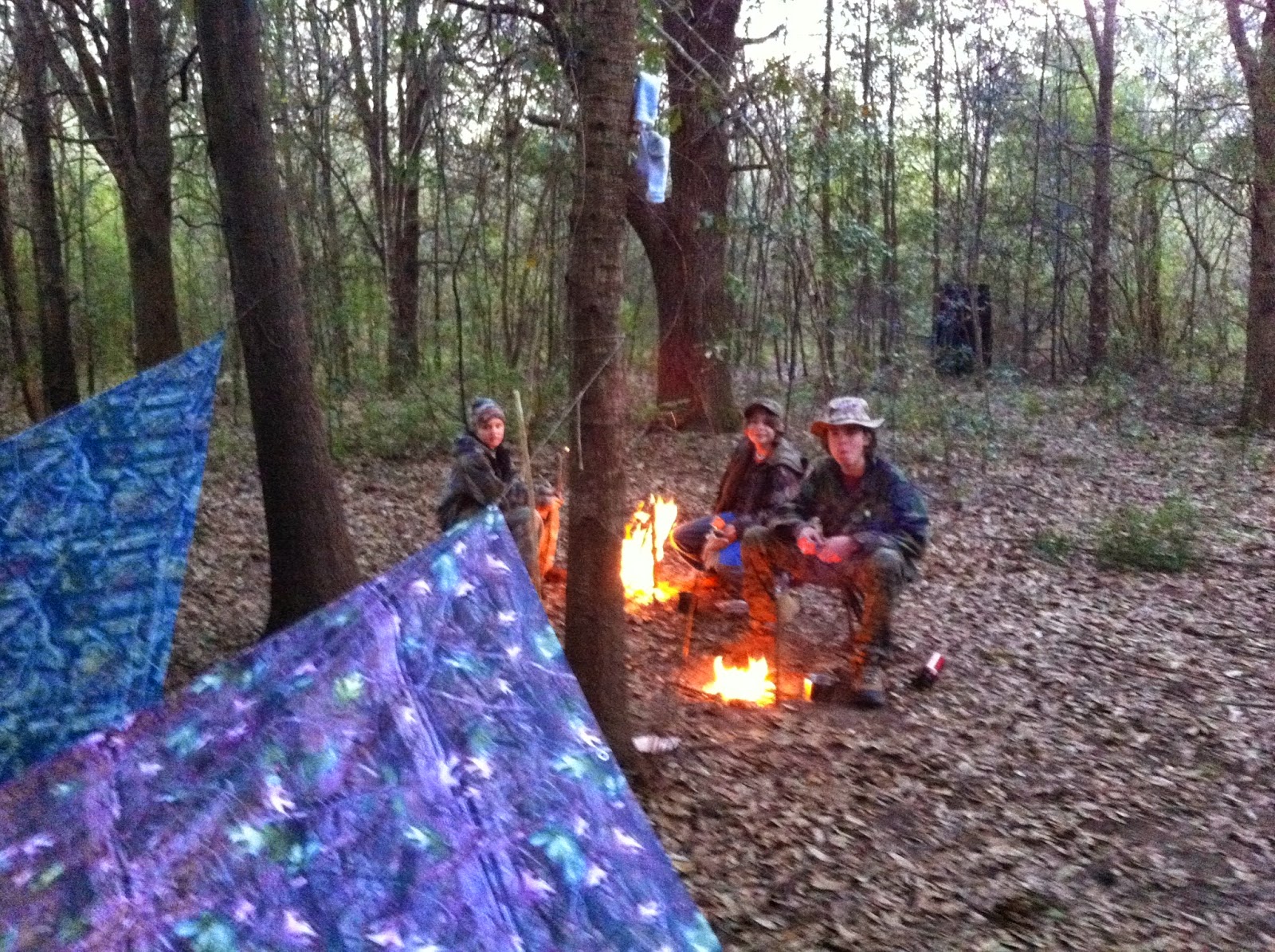
It was not, for me, startling or frightening … all the happy howling and yipping that pack of coyotes did when they got started about a hundred yards or so from our little hilltop tarp camp. It was musical with a bit of an eeriness to it. I knew they had been frequenting the area. Folks around have heard them. I have seen their tracks and scat. One of them is quite large for a coyote. A couple of medium sized. A few smaller ones. I was hoping they would run through that bottom overnight and make a little noise. I always enjoy the sounds of coyotes in the night. They came by and cut loose at 3:30. It made for a short night of sleep for some of the guys that straight away got up and got a fire going to keep the wild world out of the camp.

Predawn in the woods. That bite of chill in the air. A nice bed of coals from the night fire stirred and glowing red, some tinder and kindling added, and the resulting small flame that soon turns into a good warming fire that chases away the chill. The earliest signs of daybreak followed not long after by the first chirp of an early bird.

There is a solitude, a peacefulness, about it that is almost mystical … an experience that has no equal … vicarious, counterpart, or otherwise. This experience is the Real McCoy.

Coffee.

Breakfast.

The traps were waiting for us.

I had a little group talk with the guys and explained to them that we needed to be quiet as we went about this chore. If something was caught and upset we did not want to do anything to excite or alarm the animal as we walked in and approached it. We would check the traps in the order that we set them … check the line.

The guys were excited and anxious. I was too. That’s one of the things about trapping. You simply do not know what you will discover when you check the traps. It might be something you set for. It might be something you would rather not to have to deal with. It might be the critters were smarter than you and figured a way around your traps. Coons have been known to dig traps up and move them out of their way. It might be nothing at all and no sign of anything being there. You just don’t know until you get to the set. Then you know.

No catches. The 3rd trap, the dog proof, had a visitor during the night. It helped itself to a good few tastes of the bait but stopped helping itself to an easy meal just short of the trigger.

Finding empty traps still provided an opportunity for a brief block of instruction.

I explained to the guys that despite our best efforts, ultimately catching depends upon the animal. We do our best. We hope to catch. The rest is up to them. I explained to them that all three of the sets were good sets that would catch. Maybe not the first night. Maybe not the second. It might be the third night. Our responsibility was to keep checking them every 24 hours. It is both ethical and legal. I summed up our little impromptu “real time” meet-the-need block of instruction saying that if we were in a genuine survival situation we’d better get started digging for roots and grubs if we were going to eat.